Skip to content

A Tucson Home Funeral

The week of November 8, 2010, I served a family while caring for their elegant mother in their home – after she peacefully transitioned in her sleep. They had intensively and sensitively cared for her the past few years, so a home funeral was a very natural extension of their efforts. How they entered the work of caring for her body at home with pure stamina, gentle awareness and the tenderest kind of courage simply leaves me speechless.

As I left their home after a nearly twelve hour day of supporting their work, neighbors began visiting. The day had included an array of decisions and tending to legal details, communication, physical care and paperwork. By evening, gifts of food, flowers, wine, poetry and photos came pouring in. I paused for a bit outside, to witness expressions of both laughter and tears. I saw children, young adults and elderly all standing together to support the family. They were helping each other carry what was too big to carry alone in that moment: be it grief, relief or sadness. And all the while, the deceased was naturally lying in grace for people to sit with, too. It was poignant and oh, so very real.

This story from the New York Times yesterday, conveys many of the reasons why I feel the practice of home funerals is re-emerging. Increasingly, people want to hold celebrations for life passages at home: weddings, anniversaries, or even memorials. According to this article, 80% want to carry out the sacred act of dying at home, too.

The scenes I witnessed while serving the family I’ve described here, all illustrate the power of honest and open dialogue about caring for our own at home. What are your wishes about your final days? Do they involve being at home? Are you conveying these ideas to your loved ones? Opening ourselves to this dialogue is one of the kindest gifts we can give each other, in my humble opinion.
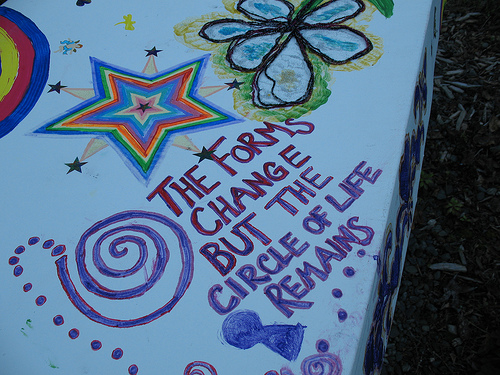
Handpainted message on a casket

Connections & Choices for Bereaved

As a Life Cycle Celebrant, I serve people at all stages of life’s milestones: new life, love and loss. I recently completed in-depth training about caring for our own at home – to help families care for their own departed. Today I found relevant articles that revealed two themes underpinning why I do this work: choices and connection for bereaved families.

One tells of the burgeoning home funeral trend, where we are returning to practices we know from our ancestors. The sobering photo in the article shows an elderly rancher looking at his coffin, handmade by his sons. It is a still shot from the film “A Family Undertaking“, which offers glimpses into contemporary family-led funerals. The other article tells how families are decreasing their funeral or memorial spending out of necessity during this slow economy. According to the independent funeral homes interviewed, families are more frequently opting out of the costliest line items and simplifying by choosing direct cremation.

Is the slow economy the only driver, I wonder? Or is this trend away from heavy spending on energy and material intensive products (steel caskets, concrete vaults and embalming) really a broader indicator? Is it a wake up call for not only Baby Boomers – yet all of us – to notice how we may return to simpler, less costly choices at the end of the road? Choices that involve deep connections through family care, support from a home funeral guide and perhaps even natural burial?

An interesting convergence of themes I think, these choices and connections for grieving families. Is a home funeral right for everyone? Well, no. Yet, with healthy planning and families holding an intention for death care at home, the end of the road may potentially become more emotionally healing and less costly in many ways.

Trends for ‘greener’ funerals

Last week I got a call from a TV Producer researching  trends in green burial and family-led home funerals. We enjoyed an open and engaging dialogue. She mentioned how she and her colleagues have discussed the topic for a few months.

More and more people are considering and even talking about (!) simpler, more meaningful after-death care and burial alternatives. I observe people seeking more personal relevance, less impact on family finances and more earth friendliness than what they usually find in today’s standard funeral practices. A recent USA Today article about the green burial trend in South Dakota reads, “People, especially baby boomers, are seeking a return to simpler times, simpler practices.” Wendell Thompson’s quote in this article nails it:

“I want something simple, dignified and environmentally sound.”

I serve as a Life Cycle Celebrant and Home Funeral Guide to help this dialogue flourish in southern Arizona. Based on training and first-hand work I’ve completed, I believe how profoundly meaningful and surprisingly achievable after-death care within families and communities is, when it fits for people.

The TV Producer’s questions indicated she is not just skimming the surface of this subject.  I hope her research efforts lead to an awareness-building production. If folks in Beverly Hills are exploring ways we can more meaningfully handle after-death care and the funeral process – and thoughtfully highlight the theme on TV somehow – I am encouraged.

Losing a dear friend

At the very core of grieving is the act of letting go.

It may be one of the biggest challenges we have. I am convinced that ritual and ceremony help us face this bittersweet challenge. To convey this idea here, I may reflect upon relevant stories from around the world. When clients permit me, I will share their powerful stories. Today, I will share a very personal story with you.

The morning of September 16th, my Tiny Girl died. She was a long-lived greyhound at 12+ years old. It is unsurprising that when I wrote my first blog entry in 2009, I mentioned her and posted our picture together. She and I ‘were a team’ as one friend often says. We met each new day together for the past 10+ years. She facilitated countless life learnings for me. She licked tears off of my face when I cried, purred like a cat when we cuddled, shared my yoga mat with me and made me guffaw with her goofy games. She holds a very tender place in my heart as a dear friend. Letting her go seemed impossible.

This is tough to write, yet vital for me to share with you. What we did after her death has helped me grieve in a healthy way and begin letting go.

We kept her body at home for the afternoon. I surrounded her with bunches of dried sage and other native plants, candles, and incense. Friends (she had a big fan club!) came to visit and say good-bye. They noticed how peaceful she looked after seeing her during recent physical struggles. My partner Brian and a close friend dug her grave in our yard. At sunset, Brian played the cello as I sat with Tiny’s body to let the day sink in a bit. I felt exhausted. Friends came over for a humble burial ceremony. We blessed Tiny’s grave in a way only she would appreciate and shared some stories about her life. I cried big bitter tears. And then, together, we covered her shell with fresh earth and flowers.

Taking these steps helped me deeply in the process of letting her go. I created a remembrance upon her grave, with a candle that remained lit for five days and nights after her burial. Whenever I miss her, I go sit there in thanks for her presence in my life and for the blessings of good friends who help me along this journey. Here is a glimpse of Tiny’s grave the morning after her burial:

morning after her burial

Tiny's grave the morning after her burial.

I hope this story inspires you. Our animal companions are such dear friends, yes? After they die, giving thoughtful time and loving energy to our grieving processes for them is extremely important. Ultimately, it will help us open up to the ache of losing them and then summon the courage to let them go.